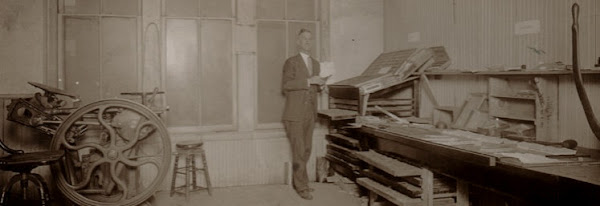


I've mentioned my friend Alan Runfeld and his Excelsior Press Museum previously and there is a link to the museum's website in the left column of this blog. He often receives donations and contributions of printing equipment for the museum. For the past several weeks I've been helping him clear out the basement print shop of his former high school print shop teacher. Some of the equipment will be incorporated into the museum but those things that would be doubles or even triples to what the museum already has will be sold to raise funds to help pay the museum's rent, electric bills, etc.
I thought I'd mention some of the items that will be coming up for sale shortly because as an amateur printer I'm always looking for things I still need for my shop and don't mind passing on a good tip. Perhaps I should point out that I have no personal interest one way or the other in any of these items or whether or not they sell other than a desire to help the museum. The museum has been of benefit to me as a printer and I know others who have also been helped by visiting the museum and taking part in its activities.
Now for the good stuff. Other items will be posted on the For Sale page of the museum's website but the three things I wanted to mention are two nice paper cutters and a paper drill. I don't remember details about the drill but it is brand-new and still in the box, never used. Both of the paper cutters were made by the Challenge Machine Company. One looks like it is from the 1940's and was made by Challenge for the Multigraph Company. It is a 19" manual cast iron tabletop cutter mounted to its original steel stand. There are a number of new wood cutting sticks with it and I believe an extra knife, as well as the original instruction manual. It is a very clean cutter and works great as I saw for myself when Alan's 80 year old shop teacher showed me a few things on it which was a real treat. It does have a safety release knob.
The second cutter is I believe from the 1980's but possibly even newer. It is also a 19" cutter but is a floor unit. The cast iron legs also make up the body where the knife holder, etc. is mounted. This is an electric cutter and is also in good working order. It has cutting sticks and possibly an extra knife as well. It has all sorts of safety features.
Alan will be posting complete information and pricing sometime soon but I just thought I'd mention them here. Please contact him directly if you're interested. Also, if you can possibly visit the museum please do so, it's a great place and Alan is very knowledgable and loves to teach. Maybe you'll even see me there!
Saturday, October 25, 2008

Friday, October 10, 2008
Tiers Of Joy
Below is another in my Bad Photo series showing my new double-tiered Tracy type cabinet. It was made by Hamilton around the turn of the century. My type collection has grown surprisingly in the last year and another cabinet was necessary. This one holds 40 full-size cases and while a few spaces will be used immediately there will be plenty of room for new fonts!
I ran out of space in the living room so the second bedroom that I've been using as an office has become the latest part of the house to be taken over by the Front Room Press. It will still remain an office with my desk, etc. but I moved out a few bookcases and it will hold several print shop items including this cabinet.
I was off from work today so spent the time cleaning it up and getting it ready for cases. It originally had two case racks on top but if I can't find any I'm going to make a full-sized bank, copying an original. It's good to be a cabinetmaker!

Sunday, September 28, 2008
Proof Of The Resurrection
As can be seen by the incredibly bad photo from my old and indequate digital camera, I pulled a proof on my newly restored galley proof press of the Ludlow slug I made at my friend Alan's shop. That started a sudden urge to pull proofs on all sorts of cuts and standing forms to test out the press. I've very satisfied with the results. It does make a deep impression on the paper, sometimes the surrounding areas that got inked by the brayer get on the paper, and there is sometimes a bit of slurring. But considering that these presses were designed for proof-reading newspaper copy it does a very acceptable job. I'm happy to have it and plan on using it regularly. I suppose I could simply beat a proof off with a hand proofer but not only do I think this is better for larger forms but it's a lot more fun. It's also exciting using such a restored piece of history that must have proofed many a newspaper form over the years.

Saturday, September 20, 2008
Wheels Within Wheels
There's been a lot of discussion on Briar Press and the LETPRESS mailing list recently about operating a press safely. One of the important factors to consider is the speed of the press. Without a treadle or variable speed motor, running the press at a slow enough speed for safe operation, whether for a beginner or experienced pressman, is not always so straightforward.
To use my press for an example: It came from a print shop where the printer had over 50 years experience. The press had a 1725 rpm motor which gave 36 impressions per minute when belted to the 24" pulley on the drive shaft. Needless to say, this was much too fast for me and probably even for many experienced printers.
The press had no treadle and an expensive variable speed motor was financially put of the question. The answer was to slow the speed down by the use of an intermediate pulley arrangement known as a countershaft. By adjusting the diameter of the pulleys in this setup the speed of the press is adjusted up or down. In this case, the pulley on the motor is a 2" V-belt pulley which is belted to a 6" V-belt pulley on the countershaft. On the end of the shaft is a 2" flat belt pulley which in turn is belted to a 24" flat belt pulley on the press. The motor, 2" and 24" flat belt pulleys came with the press.
The photo below shows my countershaft. I was fortunate in having an old motor mount with a built-in countershaft but a similar setup could easily be made out of wood and with pillow blocks, a shaft, and pulleys purchased from an industrial supplier, flea market, etc. The wide pulley under the belt is an idler pulley to keep tension on the belt and help it wrap around the small pulley better and provide more surface contact. This is not essential but I had it laying in my basement and it works well. I made the base for it out of wood, the same as can be done for the main countershaft and motor mount.
I've read and been told that 14 impressions per minute is a good speed to start for a beginner, or even slower. My press runs at 15 ipm and as a beginner I'm very comfortable with that speed. I thought I would post this to show a less common but effective, inexpensive, and relatively simple option to run the press at a safe speed.

Monday, September 15, 2008
A Watched Ludlow Never Melts
I spent some time at the Excelsior Press today with my friend Alan. We changed the wiring on one of his Ludlows and then fired it up. While waiting the 50-some minutes it took for the full lead pot to melt the type metal Alan completed some of the work for local municipalities he's been doing since the 1970's: padding, perfing, numbering, cutting to size and boring holes in multi-part dog and cat licenses.
By the time that work was done the Ludlow was ready to go and we had some fun playing with mats and hot metal. I ended up with about a dozen Front Room Press slugs in 36 point Umbria. This may lead to a new Art-Deco motif for the Press...NOT! But it was a lot of fun and the slugs will be interesting to print.
We're going to cast and print specimen sheets and Alan will be starting a hot metal casting service. He has dozens of mats so has a great selection. Look for this soon at the Excelsior Press website, a link to which is in the left column of this Blog. I also should mention that Alan has some presses (including Kelsey's), type cabinets, furniture, and many other accessories for sale. Even some nice smaller -size planers I made at work; I'm a cabinetmaker in my real life. In particular he has several nice 2/3 size type cabinets available which are great for small spaces. All proceeds go to the Excelsior Press museum. Check out his website to see more.
Tuesday, September 2, 2008
If It's Not Baroque...
...you're not supposed to fix it. But since in my case it's Rococo I'm making an exception. I have a caps with figures font of 24 point Rococo, a late 19th century face. Unfortunately it has no P's or points. I'm interested in aquiring a complete font of caps, figures and points to beef mine up, or any combination thereof. If nothing else I'd at least like to get a few P's to complete what I have. If anyone can help please contact me. Below is a photo of some examples.

Simply DeVinne
The distribution of the American Bank Note Company type continues. The Comstock has been completed but unfortunately I only have three more empty California cases. Also, I need at least one triple cap and one double cap or two triple cap cases to complete the upper case fonts. I think I need about five more California cases for the full fonts remaining. But I'm getting there. Tonight the 18 point DeVinne Extended is on the schedule. Tomorrow the 30 and 36 point Bank Script.
I also spent time this weekend distributing some used Old English in 12, 18 and 24 point that my friend Alan Runfeld of the Excelsior Press generously gave me. I have Old English in 12, 14, 18, 24, 36, and 60 point so it's sort of the house face and these additional sorts beefed up their fonts nicely. I still have a 30 point to get which will add a new point size to the collection. I got the original 6 fonts from a print shop in Elizabeth, NJ that was cleaning out much of its letterpress operation.
I've been very fortunate in terms of getting good deals on used type. This has been a necessity considering my finacial situation. I'd encourage anyone who wants to be involvd with traditional printing and is in a similar situation to do as much study and research about the craft as you can and keep your eyes open. This will pay off by enabling you to understand what you need, what is good and what isn't, and what is a bargain and what is not. Roy Underhill of The Woodwright's Shop on PBS once said that luck is where opportunity and preparation meet.
Subscribe to:
Posts (Atom)
